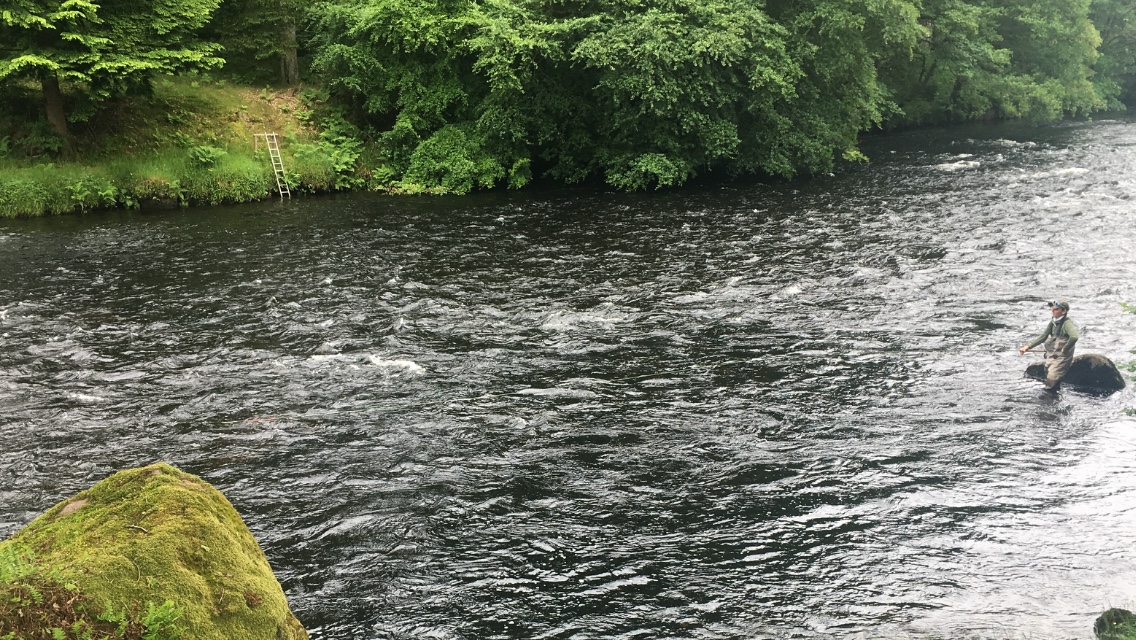
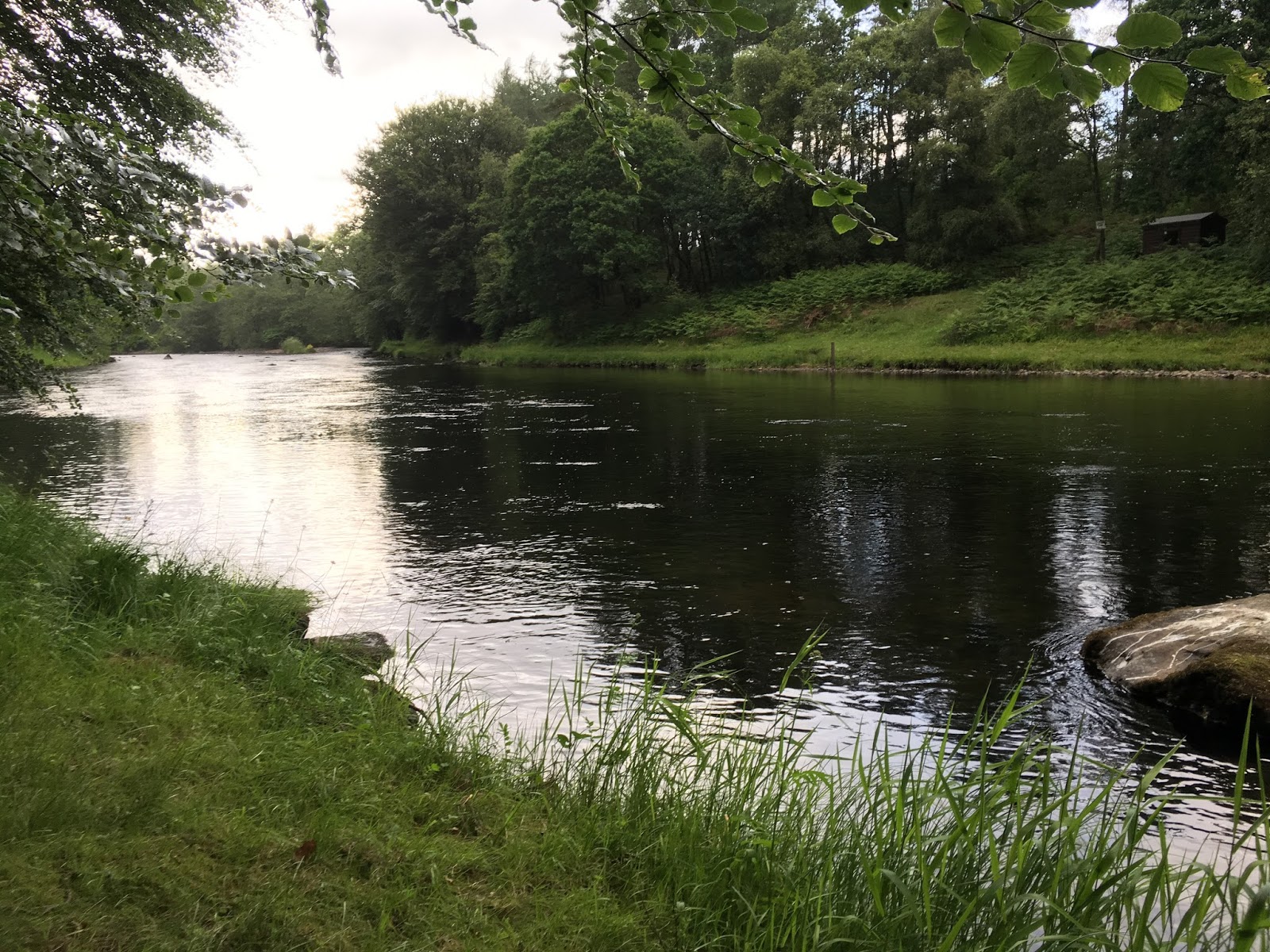
Wester Ross grilse

Wester Ross grilse
Wester Ross grilse

Thursday, 22 March 2018

Altnaharra, Naver (12-14 March 2018)

My friend John and I were lucky enough to be offered the opportunity to fish on the renowned River Naver in Sutherland in mid-March. I like fishing on many rivers in Scotland, but I do feel a sense of real privilege when I have a chance to fish a proper Highland river and the Naver is probably the cream of the crop.


Some classic Strathnaver scenery.

The rods we fished were Altnaharra rods, Altnaharra Estate having two two rod beats (one under the name of Achnabourin) on the river, the others being fished by Syre (three beats) and Skepic & Rhifail Estates (one beat plus a private stretch) respectively. We stayed in Altnaharra Hotel (no present day link) at the head of Loch Naver and the drive in past this steely stretch of water put the river system  and its various beats nicely in context before each day's fishing.


Dal Mallart pool, the junction pool with the main tributary, the River Mallajrt which comes in just below Loch Naver.


John and Rogie enjoying the fire at Altnaharra Hotel.

On day one, we were to fish the highly-regarded Beat 6, which is next up from the private and association waters and is the closest beat in the estate rotation to the sea. We were told that this was the beat to get a fish on in the cold, wintry conditions we were to fish in.

John was first to get a bend in his rod, picking up a kelt in his first run down the famous Potato Park pool. Another kelt soon followed for me, this time in the slack inside water on the left bank of Cruives, before John picked up another at the tail of the pool.


A kelt for John from Potato Park.


https://www.youtube.com/watch?v=fuFSrHg1wBY

My kelt from Cruives.

We moved on to fish Breeding Box (John) and Skelpick Bridge and Flats pools (me), respectively. Another kelt each came fairly quickly, along with some other tugs and pulls, from water which couldn't really have felt any 'fishy-er'.

The day was drawing to close when we moved downstream to give Skelpick Stream and Dal Horrisgle a go. I was a few casts into the neck of the calmer waters of Dal Horrisgle when I had a tug.  A sheep tangled up in wire on the left bank made itself known and our ghillie, Peter, headed off to save the day. Soon after, I hooked into a fish in the tail of the main stream which immediately took a few yards of line. This felt more like it. I mentioned to Peter that it felt like a springer, but as it came upstream towards me, knocking away, I left Peter to it to free the sheep. At this point, the fish turned and took five, ten, fifteen, twenty yards of line and kept going. Peter informed that it was about time to set off and so we both began the jog downstream to keep up with the fish (disclaimer: sheep now liberated). By the time it stopped, it had run right out of the pool into the next stream down. Tired from the run (the fish, not me), I put a bit of pressure on at this stage to try and capitalise. I managed to keep it under a fair degree of control in the streamy flow it was now sitting in. A few minutes passed and, after a considerable amount of pressure, the fish was holding deep in at the left bank and Peter expertly managed to net the fish from the depths.


Dal Horrisgle: the fish ran straight down through this pool and out the tail into the next stream.

On inspection, it didn't disappoint; measured at 35inches and estimated at 18lbs, it was a sparkler. A scale reading was taken (since disclosing that it was a repeat spawner - great to hear) and it was swiftly released with plenty of energy to spare. What a start to the season! The story was told a few times in the hotel that evening and it was great to put a fish in the hotel book.


Strong and fresh with no lice, the fish didn't need much recovery time.

On days 2 and 3, we were to fish the upper beats on the river, Beats 1 and 2. Both of these comprise beautiful fly pools and there is barely a stretch that you wouldn't wish to cover in a day's fishing. With the cold water (2 celsius), the consensus was that the fish were not freely moving up from the lower beats, but we gave them a good covering regardless and it was great to see more of the river.


Ceann na Coille


Lines out in Dal Harrald


Syre Pool

The end result from these beats was a further kelt from me on Beat 1 (Lower Stables) and also one for John on Beat 2 (Lower Craggie), which was hooked right on the lip of the pool, which is above a set of rapids. John and I both thought that, given the location of the hooking, it was reasonable to hold out hope for a springer, but alas not to be.


A kelt from Lower Stables for me.


Lower Craggie (a great cast) and a kelt for John.

What a beautiful place to fish and, with a week on Speyside at Craigellachie coming up, there's more to come.


Sunday, 11 February 2018

Knappach, Dee (3 February 2018)

My friend John Webster and I have a lot of fishing booked up for this season during the core months of the season and so have been relatively conservative about booking any early season fishing this year. We did agree, though, to have a quick 'season-opener' cast  on the Dee on the first Saturday of the season. Often, the best fishing around this time is in the Crathes and Banchory areas and, with the first 'proper' Winter in a few years having had an effect on water temperatures, we had been keeping an eye on rods on the lower of the early season beats around Crathes. The original plan had been to visit Crathes Castle for the day, where my dad and I had 'fished' last February Storm Doris and where the visiting John took a swim in the Boat Pool while netting a kelt for me. Ultimately, though, we ended up trying a new beat in Knappach, on the opposite bank.

The beat is a very small, two rod beat, with three main pools (arguably two and a half) to fish; however, with it being very early season and with the days being quite short, this suited us fine for the day. Most fish would be moving through, anyway, and so covering the same fish repeatedly wasn't likely to be an issue. Indeed the beat used to have a fourth pool, the Island Pool, but this was lost in the catastrophic floods of 2015/16 on Deeside and has been replaced by fairly 'bitty' water, although for the agile angler there does appear to be some pocket water to drop a fly in.

In summary, we rotated between the most likely spots - Floating Bank (Knappach has the lower half only) and Lower Birkenbaud - for the majority of the day. We did have some brief and experimental sessions in the third pool, Upper Birkenbaud, which is very fast on the Knappach side for its upper half, although the tail has some spots which look like they could hold a fish. The only action of the day came on my third cast of the morning in Floating Bank, when I briefly had hold of a fish which had taken my 1" copper Posh Tosh (a Spring favourite) fished from a 15' sink 3 tip. The fish dropped off after around 15 seconds, having given no good indicator either way as to whether it was a kelt or springer taking a break in the calmer water of the Floating Bank. 

John and I agreed that it had been an enjoyable day and that the beat does suit an early season session. Floating Bank seems a likely cold water lie and Lower Birkenbaud is a beautiful fly stream which a known locally as a good holding spot. The hut is well geared up for the colder weather and you don't need 25 pools between two people on these cold, short days. It seems likely we'll be back, somewhere along the way.

Here are some photos.


The very tail of Floating Bank.


Floating Bank; Knappach rods can fish from roughly the steps in the middle of the lower picture.


Looking up Upper Birkenbaud.


Upper Birkenbaud.


The lies in the tail of Upper Birkenbaud.


A view of the lower half of the beat, including the warm hut which looks up through Upper Birkenbaud.


John puts out a line in the main catch, Lower Birkenbaud.


The neck of Lower Birkenbaud.


Crathes Castle's map of the pools shared with Knappach rods.


John puts a line out on the Boat Pool with Brian Sim (Crathes Castle) in February 2017.


About to bag a kelt - 5 minutes later and John would be floating chest deep in here!


Tuesday, 2 January 2018

A Look Ahead To The 2018 Salmon Season

After a fairly quiet 2017 season on the blogging front, mostly to do with yet another poor Salmon season on the Tweed and Teith,  I am intending to do a bit more reporting on my various outings this coming season.

In the early season, I have trips lined up to Knappach on the Dee on the first Saturday of the season (3 February 2018), as well as further day trips to Catholes, Tay, (17 February 2018) and Upper Kinnaird, South Esk, (3 March 2018). I have 3 days on the Naver in March, followed by a week on Craigellachie, Spey, late in the month; this is a rod week which I have purchased with pal John Webster also buying into a week.

I have a syndicate rod at Old Melrose (or Ravenswood, if you prefer), Tweed, which I will get stuck into from April and, as the season progresses, I have further trips to Sluie on Deeside and a return to the Thurso, plus I hope to add in some fishing on the Inver.

Bolster Pool, Kinnaird Dyke; a classic Spring pool.

Plenty of fishing coming up, therefore, and I am planning on experimenting a bit with some more concise, photo based reports, along with the usual longer reports; feedback welcome!

I hope you all have successful 2018s and that you all get off to a good start in the next few weeks. I'd be pleased to hear how you are getting on.

Happy New Year and tight lines for 2018.

Calum


A few fish from last season which failed to make it into my reports(!):


Sunday, 25 June 2017

Cambusmore, Teith (10, 17 & 24 June)

Over the past 3 Saturdays, I have fished all bar one of the pools on Cambusmore Estate on the Teith, where I have a syndicate rod. I actually rod-shared one of these days with my friend John so, more correctly, some of these pools were fished by my rod rather than me, but close enough! In completing this tour of Cambusmore, I've compiled some fairly good pictures of some of the 30 named pools (my count) which I thought I'd share.

Saturday 10 June was spent on Cambusmore Beat 2, which seems in my relatively short experience of the estate's fishing to be the best of it. There had been heavy rain overnight and early in the day and so, while the river rose and dropped again during my fishing, I was fishing for most part at just under 2 feet on the beat's gauge (which reads a few inches lower than the online gauge based on SEPA's Callander station). These were fairly good conditions, although rising water and debris is never 'ideal'. I saw a couple of Salmon, had a few tugs and ended the day with brief encounter with a Salmon on the fly and then a 5lbs Sea Trout caught spinning in the Torrie pool.

 The Hut Pool, just after I'd set up for the session.

 The view from the hut itself.

On its way up.

 The Damhead is a famous Teith pool, just downstream from the confluence with the Kelty Water. It was lovely at this height.

 The view upstream in the Damhead.

And downstream.

There was a good bit of water coming from the Kelty; it had obviously gone up more than the Teith upstream from here.

 Kelty Mouth.

 Tail of Kelty Mouth.

No pictures of the Torrie, but I did manage this Sea Trout (kept for the table as part of my one Sea Trout, one Salmon policy), caught spinning in the tail just after losing a Salmon.

Saturday 17 June saw my friend John pay a visit for a rod-shared day on Beat 3. The level was a bit lower than the week before but not very low; around 1 foot on the beats gauge and dropping slowly. Over the course of the day, we covered most of the beat, but only saw fish in The Flats, in front of the hut. I had a pull just as John arrived and a fish was seen, but only when we returned to the pool late in the day did we see another, this time a Sea Trout.

Gean Tree is a nice cast and is fished opposite Upper Lanrick Castle.

John in The Flats.

 The neck of The Laundry.

Upstream in the Laundry.

We then fished the Lynn Pool near the top of the beat and the march with Beat 2; this is a big high water pool.

Nothing doing, other than a mid-sized brownie so we finished the day in The Flats.

Saturday 24 June was spent on Beats 4 and 5, which fish opposite Beat 1 and Gart Estate. By this time, the river was low at 6" and it was a bit of a struggle. The first and only fish seen during the day was a Sea Trout in Chirrup, at about 8pm. There seems to have been a good run of Sea Trout on the Teith this year.

Buggies - a bit low.

The Bend.

A' Na Par, seen from the hut.

It was too low for the main part of Rabbit Burrows.

Downstream from Rabbit Burrows.

 Very low in The Plasterers.

Chirrup still had some depth.

 Looking back up Chirrup.

The Sea Trout seen was spotted just upstream from the middle of the picture. 

And, finally, the view down Crow Wood.

I'm looking forward to the next significant rainfall up at Callander and Balquhidder as, when there's been water running off, there have been fish seen and caught.